
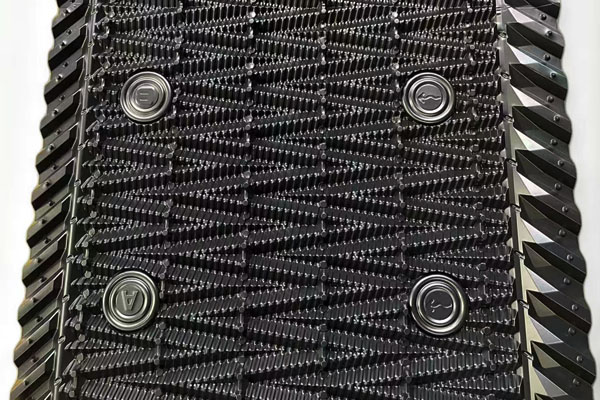
As industries continue to focus on energ
How to Choose Cooling Tower Fill When Re

The global cooling industry is experien
Not every cooling tower operates with clean water. Industrial cooling systems may contain suspended solids, dust, sludge, biological growth, oil, minerals, or process contaminants. These conditions can quickly affect Cooling Tower Fill performance and make the wrong fill design difficult to maintain.
When selecting Cooling Tower Media for an industrial application, engineers should look beyond theoretical heat transfer efficiency. Water quality, fouling risk, operating temperature, tower design, and maintenance requirements are equally important.
Film Fill provides a large contact area by allowing water to form thin films across the fill surface. However, narrow passages can become restricted when scale, solids, or biological deposits accumulate.
As fouling increases, airflow resistance may rise, water distribution can become less uniform, and effective heat transfer area can decrease. For heavily contaminated water, a more open fill structure may therefore be easier to maintain.
For suitable applications, Splash Grid Fill can be considered when resistance to clogging and cleaning practicality are more important than achieving the highest possible heat transfer rate.
There is no universal answer. Film Fill is attractive when water quality is well controlled and high thermal performance is required. Splash-type fill can be more practical where suspended solids, fouling, or frequent cleaning are major concerns.
The key question is not simply which Cooling Fill has the highest efficiency, but which design can maintain acceptable performance under the actual water conditions of the plant.
High-temperature or chemically demanding applications also require careful material selection. PP Cooling Tower Fill may be considered for applications requiring greater temperature or chemical resistance, while PVC remains suitable for many standard operating conditions.
Material should always be selected according to the actual water chemistry, operating temperature, and exposure conditions rather than assuming one material is suitable for every project.
Older cooling towers can be especially challenging because the original fill may no longer be available, tower loads may have changed, and support structures may have been modified.
For crossflow replacement projects, products such as Wide-width Cross-flow Fill and 16.5 Multi-width Cross-flow Fill can be evaluated according to the existing tower dimensions and installation requirements.
Before ordering replacement fill, confirm the tower type, fill width and length, fill height, water flow, operating temperature, and available support structure. Accurate measurements can help prevent bypass airflow and installation problems.
Even the right Cooling Tower Fill can suffer premature performance loss if water quality is poorly controlled. Scale control, biological treatment, suspended-solids management, blowdown, and regular inspection should be part of the maintenance strategy.
Operators should also inspect air inlet louvers, drift eliminators, water distribution systems, and fill channels during scheduled maintenance. A gradual increase in outlet water temperature can be an early sign that fouling or another tower problem needs attention.
The best Cooling Tower Fill for dirty industrial water is not necessarily the fill with the largest theoretical surface area. It is the solution that can maintain reliable cooling performance while remaining practical to inspect, clean, and maintain.
For controlled water conditions, Film Fill Cooling Tower solutions can provide efficient heat transfer. Where fouling resistance and open passages are more important, splash-type structures may be a better fit.
Choose Cooling Tower Media according to the water, temperature, airflow, and maintenance conditions that actually exist in the plant.
Cooling Tower Fill Media industry updates and technical insights for global clients.
As industries continue to focus on energy efficiency and water conservation, cooling tower fill has
Cooling Tower Maintenance in Food and Beverage Plants: When Fill Fouling Becomes a Production Proble
Get in touch with our team for cooling tower fill media details, quotations, and project technical support.
Chat on WhatsApp