
As industries continue to focus on energ
How to Choose Cooling Tower Fill When Re

The global cooling industry is experien
When discussing cooling tower replacement fill for a project in Malaysia, customers sometimes begin by explaining that the equipment operates in a hot and humid climate.
That information is useful, but it is not enough to select the replacement media.
For an evaporative cooling tower, the design wet-bulb temperature is one of the most important operating parameters.
A tower operating in Kuala Lumpur, Penang, or Johor should be evaluated using the actual design conditions of the installation rather than a general description of tropical weather.
Cooling towers reject heat partly through water evaporation.
The ambient wet-bulb temperature influences how low the circulating water temperature can approach under a given operating condition.
When the wet-bulb temperature is high, achieving a low outlet water temperature becomes more demanding.
This does not necessarily mean the fill is performing poorly.
A replacement project should therefore begin with the required entering and leaving water temperatures, circulating flow rate, and design wet-bulb temperature.
Suppose a maintenance team reports that the cooling tower cannot reach the desired outlet water temperature during humid weather.
Before recommending new fill, I would ask whether the tower was originally designed to achieve that temperature under the current wet-bulb conditions.
If the requested outlet temperature is below what the existing system can reasonably achieve, replacing the media alone will not solve the problem.
The complete thermal duty must be reviewed.
For replacement projects, the existing fill dimensions and installation method remain important.
A counterflow tower may use compact media sections, while a larger installation may require wider fill assemblies.
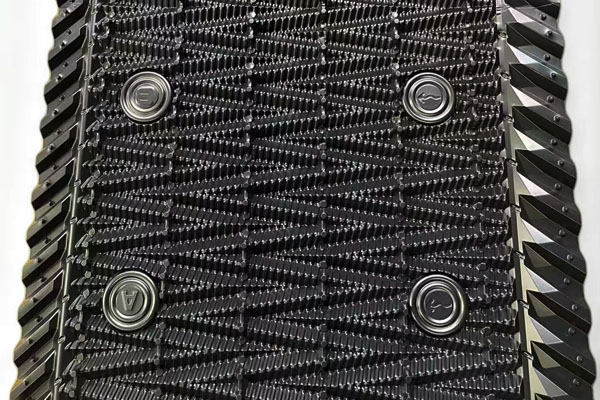
For example, 18mm pitch counterflow cooling tower fill for different tower sizes provides dimensional options that may be relevant to a replacement project.
However, the replacement must also match the tower's thermal and airflow requirements.
Humidity and water quality are different issues.
A cooling tower may operate in a humid climate while using relatively clean circulating water.
Another tower in the same region may experience severe scaling or suspended-solids accumulation because of its water treatment conditions.
The fill structure should be selected according to the actual circulating water characteristics.
Where narrow film fill passages experience persistent fouling, splash grid fill for fouling-prone cooling water may be worth evaluating as an alternative.
Any change from film fill to splash fill requires a thermal and mechanical compatibility assessment.
For a cooling tower replacement project in Malaysia, I would recommend providing the following:
If the tower requires wider media sections, wide-width film fill for counterflow cooling tower applications can be considered when reviewing dimensional compatibility.
For cooling tower replacement fill in Malaysia, don't choose a product simply because it is described as suitable for tropical climates.
Start with the actual thermal design conditions and the existing tower arrangement.
Then evaluate the media geometry, water quality, and installation requirements.
A replacement that matches the tower's real operating conditions is far more useful than one selected from a general climate description.
Cooling Tower Fill Media industry updates and technical insights for global clients.
As industries continue to focus on energy efficiency and water conservation, cooling tower fill has
Cooling Tower Maintenance in Food and Beverage Plants: When Fill Fouling Becomes a Production Proble
Get in touch with our team for cooling tower fill media details, quotations, and project technical support.
Chat on WhatsApp