
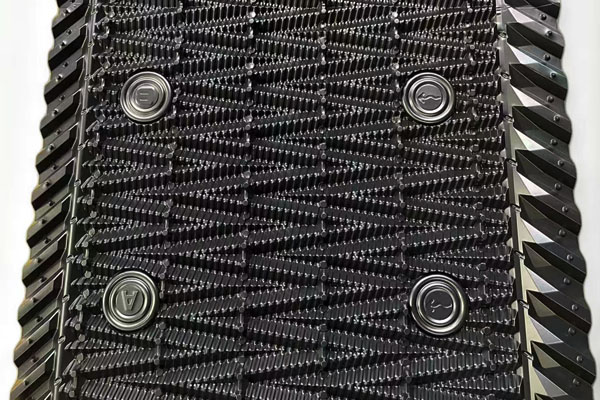
As industries continue to focus on energ
How to Choose Cooling Tower Fill When Re

The global cooling industry is experien
Textile and dyeing plants can have changing cooling loads because compressors, chillers, heat exchangers and process equipment may not operate at the same time.
This makes Cooling tower media selection a practical engineering issue rather than simply a product replacement decision.
Cooling water quality can vary between textile facilities. Suspended solids, mineral deposits and biological growth may gradually accumulate on the fill surface and restrict internal passages.
As fouling increases, water distribution and airflow through the fill can become less uniform. Regular water treatment and inspection are therefore important parts of maintaining cooling performance.
Film-type fill is often considered when high heat-transfer performance is required within a limited tower volume. Its corrugated sheets create passages that allow water and air to interact over a relatively large surface area.
Where the water contains more suspended material, an open splash structure may be worth evaluating because larger passages can make blockage and maintenance less demanding in suitable applications.
The choice of Cooling tower packing should therefore consider thermal duty, water quality, available fill volume and maintenance requirements together.
Counterflow and crossflow towers use different airflow arrangements, so the fill must match the existing water distribution and air path.
Engineers should also confirm operating water temperature, flow rate and cooling load before selecting replacement fill. A specification that works in one tower may not provide the same result in another installation.
Many textile production regions have warm and humid climates, which can increase biological growth when water treatment is poorly controlled.
For retrofit projects, do not rely only on the original tower drawing. Years of repairs or modifications may have changed the actual installation dimensions.
Before ordering replacement fill, confirm the fill dimensions, support structure, tower type, water flow and operating temperatures. Photos of the existing installation can also help determine whether the proposed fill arrangement is practical.
Textile and dyeing plants need Cooling Tower Fill that matches their actual production load, water conditions and tower configuration.
The right solution is not necessarily the fill with the highest theoretical efficiency. It is the cooling tower packing that can provide suitable heat transfer while remaining practical to maintain under the plant's real operating conditions.
Cooling Tower Fill Media industry updates and technical insights for global clients.
As industries continue to focus on energy efficiency and water conservation, cooling tower fill has
Cooling Tower Maintenance in Food and Beverage Plants: When Fill Fouling Becomes a Production Proble
Get in touch with our team for cooling tower fill media details, quotations, and project technical support.
Chat on WhatsApp