
As industries continue to focus on energ
How to Choose Cooling Tower Fill When Re
The global cooling industry is experien
An aging cooling tower does not always need a complete rebuild. In many industrial plants, the tower structure remains usable while cooling performance gradually declines due to fouled fill, restricted airflow, changes in water flow, or aging mechanical components.
Replacing Cooling Tower Fill can help, but the retrofit should be evaluated as a complete air-water system rather than as a simple component replacement.
Reduced airflow can have several causes, including fouled fill, blocked air passages, damaged louvers, fouled drift eliminators, fan deterioration, or changes in operating conditions.
Before replacing the fill, engineers should check whether the actual problem is insufficient airflow, excessive resistance, poor water distribution, or a combination of these factors.
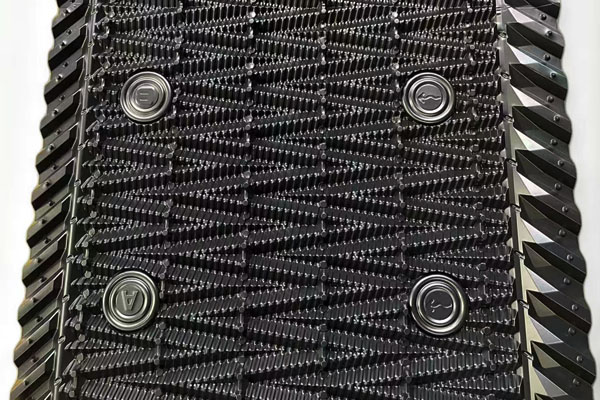
Film fill contains structured passages that provide a large air-water contact area. When scale, biological deposits, or other contaminants accumulate, the available passages can become restricted and airflow resistance may increase.
However, the solution is not always to select a more open or lower-resistance fill. The replacement must still provide the required heat-transfer performance at the tower's actual water and air conditions.
Crossflow towers use horizontal airflow through the fill, so the replacement structure should match the tower's fill depth, water distribution system, airflow path, and available installation space.
For retrofit projects requiring a suitable crossflow configuration, Multi-Specification Cross Flow Cooling Tower Fill can be evaluated according to the existing tower dimensions and operating requirements.
An old tower may have non-standard fill dimensions, modified support structures, or several cells with different layouts. Simply selecting a newer fill based on thermal performance can create installation or airflow problems if the geometry does not match.
For replacement projects, confirm the existing fill width, length, thickness, support arrangement, water flow and available fill volume before placing an order.
Where the existing tower requires a film-fill solution, Film Fill Cooling Tower can be considered based on the tower type and required operating conditions.
An aging cooling tower does not automatically require replacement. A properly evaluated Cooling Tower Fill retrofit can restore useful cooling performance while keeping the existing structure in service.
The key is to match the new fill to the tower's actual geometry, water loading, airflow and operating conditions. For retrofit projects, accurate measurements and a clear understanding of the existing system are often more important than simply choosing the highest-performance fill on paper.
Cooling Tower Fill Media industry updates and technical insights for global clients.
As industries continue to focus on energy efficiency and water conservation, cooling tower fill has
Cooling Tower Maintenance in Food and Beverage Plants: When Fill Fouling Becomes a Production Proble
Get in touch with our team for cooling tower fill media details, quotations, and project technical support.
Chat on WhatsApp