
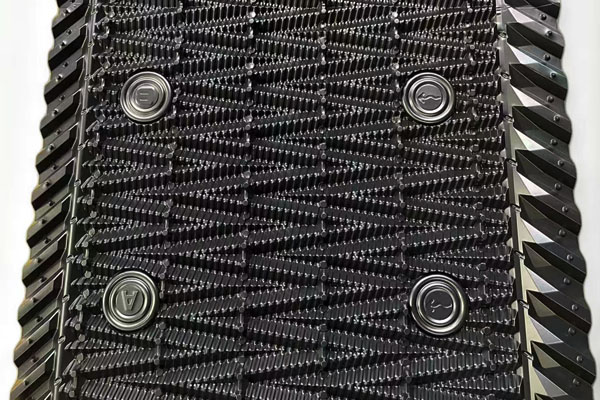
As industries continue to focus on energ

How to Choose Cooling Tower Fill When Re

The global cooling industry is experien
Cooling towers installed near the coast operate in an environment that can differ significantly from inland systems. Moisture and salt particles in the surrounding air may enter the tower, while the circulating water may also contain concentrated minerals depending on the water source and treatment program.
For Cooling Tower Fill, the important issue is not simply that the tower is near the sea. The actual exposure, water chemistry, tower configuration and maintenance conditions should all be considered when evaluating fill selection and service condition.
Sea air can introduce salt particles and moisture into the cooling tower airflow path. The amount of exposure varies with the distance from the coastline, wind conditions and local environment.
This does not normally mean that the fill will fail simply because the tower is coastal. Instead, long-term exposure can contribute to deposits and deterioration of components, particularly when combined with unsuitable water chemistry or insufficient maintenance.
These are different issues and should not be treated as the same problem. Airborne salt is mainly an environmental exposure, while mineral concentration in circulating water is strongly influenced by make-up water quality, cycles of concentration and water treatment.
In a counterflow tower, air moves upward while water flows downward through the fill. Fill selection should consider the available fill volume, water distribution, airflow and operating conditions.
Crossflow towers introduce air horizontally through the fill area, making the existing fill dimensions and air path particularly important during replacement.
For replacement projects, Full-width Cross-flow Fill can be considered when its configuration and dimensions match the existing crossflow tower structure.
Not automatically.
There is no universal rule that every coastal cooling tower needs a special Cooling Tower Media configuration. The decision should be based on tower type, operating temperature, water quality, environmental exposure and maintenance requirements.
In many installations, conventional plastic fill can remain suitable when the material and structure are correctly matched to the application.
Rather than replacing Cooling Tower Fill simply because the tower is located near the coast, operators should monitor its actual condition.
If cooling performance declines, the fill should not automatically be identified as the cause. Airflow, water distribution, fan performance and water treatment should also be checked.
The marine environment can affect exposed cooling tower components as well. During a planned inspection, operators should assess the complete air and water path rather than focusing only on the fill.
This is particularly important when an older coastal tower is being considered for a fill replacement or internal upgrade.
When evaluating a coastal cooling tower, the first step should be to collect the actual application data: tower type, existing fill dimensions, water temperature, flow rate, water chemistry and maintenance history.
These details help determine whether the existing fill can be replaced directly or whether a different configuration is more appropriate. For crossflow replacement projects, confirming the available width and installation space before ordering is especially important.
Coastal location can change the operating environment of a cooling tower, but salt-laden air alone does not determine the correct Cooling Tower Fill.
The more reliable approach is to evaluate environmental exposure together with water chemistry, tower structure, airflow and maintenance history. This helps avoid unnecessary material changes while identifying genuine fouling, dimensional or performance problems before they become costly.
Cooling Tower Fill Media industry updates and technical insights for global clients.
As industries continue to focus on energy efficiency and water conservation, cooling tower fill has
Cooling Tower Maintenance in Food and Beverage Plants: When Fill Fouling Becomes a Production Proble
Get in touch with our team for cooling tower fill media details, quotations, and project technical support.
Chat on WhatsApp