
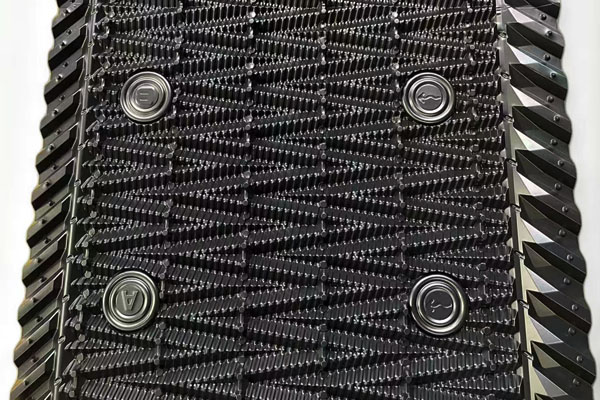
As industries continue to focus on energ
How to Choose Cooling Tower Fill When Re

The global cooling industry is experien
Cooling towers are often evaluated under full production conditions, but many industrial plants do not operate at full load all year round. During low-load periods, the behavior of the Cooling Tower Fill can look quite different.
Reduced water flow, changes in fan operation and uneven water distribution can all influence how effectively the fill performs when the tower is operating below its original design condition.
Film Fill depends on water being distributed across its surface while air passes through the fill.
When the circulating water flow drops significantly, the wetting condition inside the Cooling Tower Media can change. Some areas may receive less water than they would under full-load operation, which can affect the way the available fill surface is being used.
This does not automatically mean that the fill is unsuitable. It means the tower is operating under a different condition from its original design point.
In counterflow applications, fill performance depends on the relationship between upward airflow, downward water flow and the available fill volume.
Crossflow towers use a different arrangement, with air entering horizontally through the fill. For towers with variable operating loads, the available fill width and installation configuration should be checked before selecting a replacement.
For applications where the existing tower requires a wider crossflow configuration, 1060mm & 1160mm Cross Flow Cooling Tower Fill for Replacement Projects can be evaluated according to the available tower dimensions and operating requirements.
If a tower performs well at high load but shows unusual temperature behavior at low load, the first step should be checking actual water flow, fan operation and water distribution conditions.
The problem may be related to how the tower is being operated rather than a failure of the existing Cooling Tower Fill.
Replacing Cooling Tower Media without understanding the operating condition may therefore not solve the underlying issue.
Plants with highly variable cooling loads may need to consider more than the nominal thermal performance of the fill.
The fill structure, dimensions, water loading and airflow characteristics should be evaluated together with the tower's expected operating range.
For crossflow towers requiring different width configurations, Multi-Specification Cross Flow Cooling Tower Fill can provide a practical option when the existing tower requires a specific fill width.
Low load itself does not automatically mean that a tower should switch from Film Fill to Splash Grid Fill.
However, if variable operating conditions are combined with fouling-prone water, an open fill structure may sometimes be worth evaluating.
How Does Splash Grid Fill Handle Fouling-Prone Cooling Water can be useful as a reference when comparing fill structures for applications where blockage and water cleanliness are important considerations.
Older cooling towers can have different internal dimensions because of previous repairs, modifications or earlier fill replacement projects.
Before ordering replacement Cooling Tower Fill, operators should confirm the actual fill width, length, thickness, available height and support arrangement.
For towers requiring a specific crossflow width, 1010mm Width Cross Flow Cooling Tower Fill is one example of a dimension-specific solution that can be evaluated against the existing installation.
When customers are evaluating fill replacement for towers with highly variable loads, we can review the tower configuration, existing Cooling Tower Media, fill dimensions and operating conditions before recommending a replacement.
Where appropriate, we can also provide customized fill configurations instead of simply supplying a standard product.
A cooling tower is not always operating at its design point. If the plant frequently runs at partial load, the Cooling Tower Fill should be considered as part of the complete operating system rather than evaluated from one operating condition alone.
The right approach is to evaluate water flow, airflow, distribution, fill dimensions and actual cooling requirements across the tower's expected operating range.
This makes it easier to determine whether the existing fill is genuinely limiting performance or whether the operating strategy itself needs to be adjusted.
Cooling Tower Fill Media industry updates and technical insights for global clients.
As industries continue to focus on energy efficiency and water conservation, cooling tower fill has
Cooling Tower Maintenance in Food and Beverage Plants: When Fill Fouling Becomes a Production Proble
Get in touch with our team for cooling tower fill media details, quotations, and project technical support.
Chat on WhatsApp