
As industries continue to focus on energ
How to Choose Cooling Tower Fill When Re

The global cooling industry is experien
Power plants depend on cooling systems to remove large amounts of waste heat generated during electricity production. Whether it is a thermal power plant, combined cycle power plant, or other large-scale energy facility, the cooling tower plays a critical role in maintaining stable operation.
Inside every cooling tower, the Cooling Tower Fill is one of the most important components affecting heat transfer efficiency. A properly selected fill system improves water and air contact, supports stable cooling performance, and helps reduce operating costs over the long term.
For power plant operators, choosing the right Cooling Tower Media is not simply a replacement decision. It is a long-term reliability decision that affects cooling capacity, maintenance frequency, and overall plant efficiency.
Compared with commercial cooling systems, power plant cooling towers usually handle much higher water flow rates and operate under more demanding conditions.
The Cooling Fill inside the tower must provide:
Many power plants operate continuously throughout the year. Unexpected cooling system problems can directly affect generation capacity and operational stability.
Therefore, Cooling Tower Fill should be selected based on long-term reliability rather than only initial purchase cost.
Power plant cooling towers usually require fill designs that can handle large amounts of circulating water while maintaining effective air and water contact.
The internal structure of the fill plays an important role in balancing:
Outdoor cooling towers are exposed to sunlight, temperature changes, and environmental conditions.
Material selection becomes especially important for long-term applications.
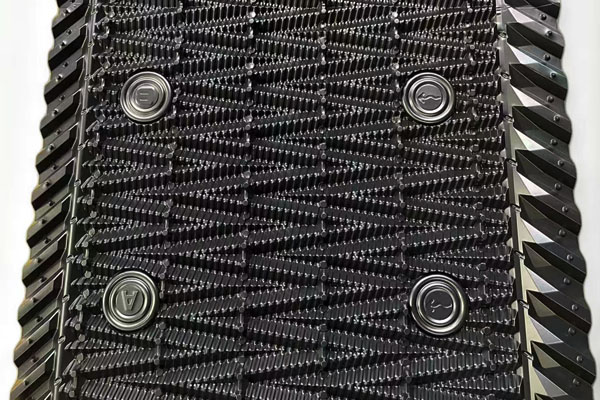
Film Fill is commonly used when high thermal efficiency is required because it creates a large surface area for water film formation.
Film Fill Cooling Tower is widely applied in counterflow cooling tower designs where vertical airflow and water flow work together.
For crossflow cooling towers, 16.5 Multi-width Cross-flow Fill can provide efficient heat exchange under horizontal airflow conditions.
Some power plant cooling towers operate with water conditions that make splash-type solutions more suitable.
Splash Grid Fill is often considered for applications where durability and resistance to fouling are important factors.
Compared with traditional film fill, splash designs can offer advantages in environments with higher suspended solids or more challenging water conditions.
PVC Cooling Tower Fill is commonly selected for many cooling tower applications because it provides reliable cooling performance and good cost efficiency.
It is suitable for many standard operating conditions where water quality is properly managed.
PP Cooling Tower Fill is often selected for more demanding environments requiring higher temperature resistance or improved chemical stability.
Water quality is one of the most important factors affecting Cooling Tower Fill service life.
Power plants may experience issues such as:
The selected fill structure should match the actual water conditions.
Different cooling tower designs require different fill solutions.
Before replacement, operators should confirm:
Large power plants usually have scheduled maintenance periods. Cooling Tower Fill selection should consider inspection, cleaning, and replacement requirements.
Aging or damaged fill can reduce effective heat transfer area, causing higher outlet water temperatures.
Long-term exposure to heat, chemicals, and environmental conditions may cause plastic fill materials to become brittle or deformed.
Even high-quality Cooling Tower Media cannot perform properly without good water distribution.
During maintenance projects, the complete tower system should be inspected.
When replacing cooling tower fill, operators should also inspect other important components.
For power plant cooling towers, the most suitable Cooling Tower Fill is the one that matches actual operating conditions.
A high-efficiency fill design may not always be the best choice if water quality is poor or maintenance conditions are limited.
Successful projects usually balance cooling performance, durability, maintenance requirements, and long-term operating costs.
The choice depends on cooling tower design and operating conditions. Film Fill and Splash Grid Fill are both used in different applications.
Yes. Film Fill is widely used in many large cooling systems because of its high heat transfer efficiency.
Replacement timing depends on material condition, cooling performance, water quality, and maintenance history.
Cooling Tower Fill is a key component in power plant cooling systems. The right selection can improve heat transfer efficiency, support stable operation, and reduce future maintenance challenges.
By considering cooling tower design, water quality, material selection, and operating requirements, power plant operators can choose a Cooling Tower Media solution that delivers reliable long-term performance.
Cooling Tower Fill Media industry updates and technical insights for global clients.
As industries continue to focus on energy efficiency and water conservation, cooling tower fill has

Why Cooling Tower Fill May Not Fit Properly After ReplacementReplacing cooling tower fill sounds str
Get in touch with our team for cooling tower fill media details, quotations, and project technical support.
Chat on WhatsApp