
As industries continue to focus on energ
How to Choose Cooling Tower Fill When Re

The global cooling industry is experien
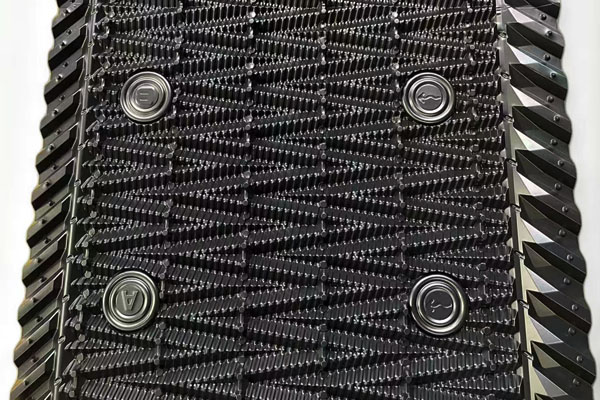
Cooling tower fill is the heat-exchange core, increasing air-water contact area to enhance heat dissipation. Modern fills are commonly made of PVC or PP, offering corrosion resistance and light weight. Proper selection directly impacts cooling performance, energy consumption, and service life.
Counterflow towers have opposing air-water flow and are commonly designed with film fill to provide uniform water distribution and effective heat transfer.
Crossflow towers use horizontal airflow through the fill section. For replacement projects, 1060mm & 1160mm Cross Flow Cooling Tower Fill for Replacement Projects can be considered when the existing tower dimensions require these replacement widths.
For other crossflow configurations, 1010mm Width Cross Flow Cooling Tower Fill provides another dimensional option for replacement applications.
For sandy, fouling-prone, or high-solids water, Splash Grid Fill can be considered because its open structure is less susceptible to blockage than tightly spaced film fill.
PVC is widely used for normal cooling tower operating conditions because of its balance between thermal performance, durability, and cost. PP can be considered for applications requiring higher temperature resistance or greater chemical resistance.
Common structures include corrugated fill and fluted fill, with angles and spacing designed to balance airflow resistance, water distribution, and heat transfer efficiency.
Film fill generally provides high heat-transfer efficiency because of its large effective surface area, but its narrower channels can also create greater airflow resistance. Fill selection should therefore be matched with the tower's fan and operating conditions.
Standard sheets can be cut for some applications, but retrofit projects should be based on accurate tower dimensions. Correct sizing helps reduce gaps, bypass airflow, and installation problems.
Also inspect Cooling Tower Air Inlet Louvers and Drift Eliminators as part of routine cooling tower maintenance.
Selection depends on tower type, water quality, thermal load, and operating conditions. Film fill is generally suited to applications where efficient heat transfer and good water quality can be maintained, while splash grid fill can be considered for fouling-prone water. Accurate sizing and regular maintenance help maintain cooling performance and extend fill service life.
Cooling Tower Fill Media industry updates and technical insights for global clients.
As industries continue to focus on energy efficiency and water conservation, cooling tower fill has
How Can Fill Cutting Affect Airflow Inside a Cooling Tower?During cooling tower fill installation, c
Get in touch with our team for cooling tower fill media details, quotations, and project technical support.
Chat on WhatsApp