
As industries continue to focus on energ
How to Choose Cooling Tower Fill When Re

The global cooling industry is experien
A customer once asked whether replacing an old fill pack with a more compact, higher-surface-area structure would improve cooling performance.
My first question was about the fan.
That may sound unrelated to the fill, but the fan and packing cannot be evaluated independently.
Changing the internal geometry of the cooling tower packing can change the resistance that the fan must overcome.
Air passing through cooling tower fill experiences resistance from the internal channel surfaces and changes in flow direction.
The amount of resistance depends on the media geometry, airflow rate, water loading, and operating condition.
Two fill packs with the same external dimensions can have different pressure-drop characteristics.
This is why comparing only the nominal surface area is not enough when selecting replacement media.
A cooling tower fan operates at the point where its performance curve intersects the system resistance curve.
If the fill replacement increases the system resistance, the operating airflow may change.
The actual result depends on the fan characteristics and the complete air path.
A reduction in airflow can offset some of the expected thermal benefit from a different fill structure.
For this reason, I would review available fan performance information before approving a major change in media geometry.
Corrugation pitch is useful information, but it does not fully describe the internal airflow path.
The corrugation angle, sheet arrangement, channel intersections, and surface geometry also matter.
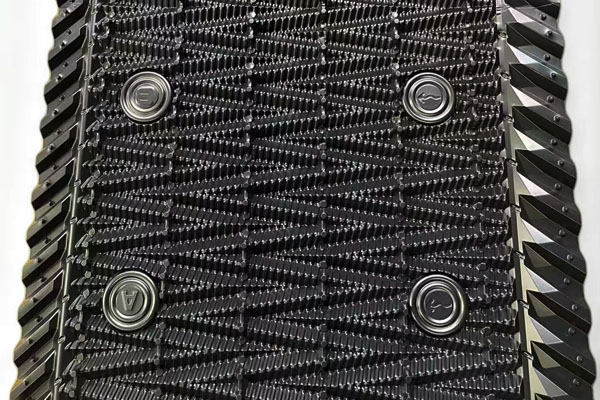
For example, 18mm pitch cooling tower fill for counterflow configurations represents one geometry that should be evaluated using the complete product specification.
It should not be assumed to have the same pressure drop as every other fill with an 18mm nominal pitch.
Another detail worth remembering is that cooling tower fill operates with circulating water flowing through it.
The presence of water can affect the airflow resistance.
A dry laboratory comparison may not fully represent the resistance under actual operating water loading.
When comparing different fill products, make sure the performance information is based on relevant operating conditions.
Large counterflow towers may use wide media sections to suit the internal layout.
Products such as wide-width film fill for counterflow cooling tower applications can be considered when checking dimensional requirements.
However, increasing the physical size of a fill section does not establish its thermal suitability.
The proposed media must be evaluated against the available airflow, water loading, and required cooling duty.
I would begin by collecting the original fill specification and the tower's design operating data.
Then I would compare the proposed media geometry and available thermal and pressure-drop information.
For general product comparison, cooling tower packing options provide a starting point for reviewing different media arrangements.
If the proposed replacement differs significantly from the original, a proper thermal and airflow evaluation is advisable.
When upgrading cooling tower packing, don't focus only on heat transfer surface area.
Ask how the proposed fill will affect the tower's airflow resistance.
A suitable replacement should provide the required thermal performance while remaining compatible with the fan and the complete cooling tower system.
That is a more reliable approach than selecting a fill simply because its structure appears denser or more advanced.
Cooling Tower Fill Media industry updates and technical insights for global clients.
As industries continue to focus on energy efficiency and water conservation, cooling tower fill has

Cooling Tower Packing Pressure Drop: When a Fill Upgrade Changes the Fan Operating PointA customer o
Get in touch with our team for cooling tower fill media details, quotations, and project technical support.
Chat on WhatsApp