
As industries continue to focus on energ
How to Choose Cooling Tower Fill When Re

The global cooling industry is experien
When engineers evaluate cooling tower performance, Cooling Tower Fill is often the first component they examine. However, a well-designed fill cannot perform properly if airflow entering the tower is restricted or uneven.
In retrofit projects, replacing the fill does not always solve poor cooling performance. Fan problems, blocked air inlets, damaged louvers, and uneven airflow can limit heat transfer even when the Cooling Tower Fill itself is in good condition.
Cooling Tower Fill provides the surface where air and circulating water interact. Airflow then carries heat and moisture away from the water.
If airflow is poorly distributed, some parts of the fill may receive insufficient air while other areas receive more than necessary. The result can be uneven heat transfer across the tower.
This is why fill selection should always be considered together with the tower's airflow conditions.
Dust, leaves, debris, and industrial contaminants can gradually restrict air entering the tower. The effect may develop slowly and become noticeable only when cooling performance starts to decline.
Damaged or missing louvers can disturb the intended airflow path before air reaches the fill section. This can create uneven air distribution and reduce the effective use of the available fill area.
Worn fan blades, incorrect blade settings, belt problems, or reduced motor speed can lower airflow volume. Replacing Cooling Tower Fill without checking the fan system may therefore produce limited improvement.
Counterflow towers move air upward through the fill while water flows downward. The fill must provide sufficient air-water contact without creating excessive airflow resistance.
For applications using film-type structures, Film Fill Cooling Tower can be selected according to the tower configuration and required operating conditions.
Crossflow towers introduce air horizontally through the fill section. Uniform airflow across the fill is therefore particularly important when evaluating cooling performance.
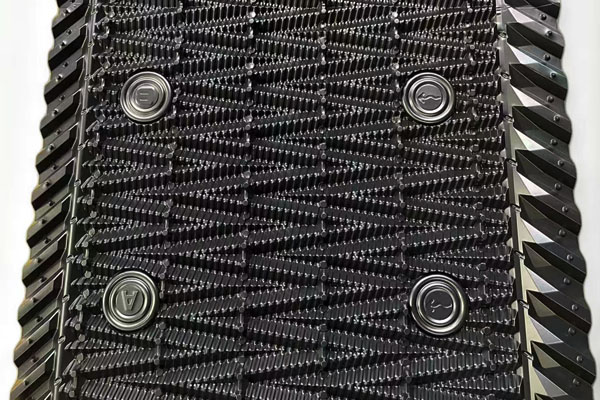
For crossflow retrofit applications, Multi-Specification Cross Flow Cooling Tower Fill provides different width options that can be matched to the confirmed tower dimensions.
Not necessarily. A higher-performance fill design still depends on adequate airflow, water distribution, and operating conditions.
If the fan system is already operating below the required airflow, installing a different fill may produce less improvement than expected. In some cases, a fill with greater airflow resistance can also increase the demand on the fan system.
For older crossflow towers, dimensional verification is especially important. Products such as 16.5 Multi-width Cross-flow Fill should only be selected after confirming that the width and installation arrangement are suitable for the existing tower.
Fill structure should also be selected according to water quality and operating conditions. A compact film structure can provide efficient heat transfer when water quality is suitable, while more open structures may be considered where fouling and blockage are major concerns.
The objective is not simply to choose the highest-efficiency fill, but to select a structure that can operate reliably with the available airflow and water conditions.
Before contacting a Cooling Tower Fill manufacturer, prepare the tower type, existing fill dimensions, operating temperature, water conditions, and photographs of the installation.
This information allows the supplier to evaluate the actual application rather than recommending a product based only on block dimensions.
When cooling performance falls, replacing the fill should not automatically be the first step. Check whether the tower is receiving the airflow and water distribution required by the existing fill design.
If the airflow problem is corrected first, the need for replacement can be evaluated more accurately. If new fill is required, its geometry and dimensions should then be matched to the tower's actual operating conditions.
Cooling Tower Fill is an important part of heat transfer, but it cannot compensate for inadequate airflow. Fan performance, air inlet condition, airflow distribution, water distribution, and fill design must work together.
Before replacing the fill, identifying the actual source of performance loss can prevent unnecessary costs and lead to a more reliable cooling tower upgrade.
Cooling Tower Fill Media industry updates and technical insights for global clients.
As industries continue to focus on energy efficiency and water conservation, cooling tower fill has

Why Fill Block Depth Matters More Than Its Width in Some Counterflow ApplicationsWhen purchasing rep
Get in touch with our team for cooling tower fill media details, quotations, and project technical support.
Chat on WhatsApp