
As industries continue to focus on energ
How to Choose Cooling Tower Fill When Re

The global cooling industry is experien
One question often comes up during cooling tower retrofit projects: can different Cooling Tower Fill types be installed in the same tower?
The answer is sometimes yes, but it should not be treated as a simple replacement. Different fill structures can have different airflow resistance, water distribution requirements, and heat transfer characteristics.
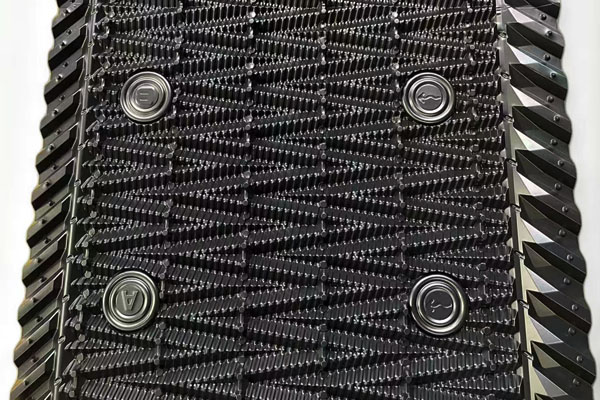
Fill geometry determines how water spreads through the pack and how air moves through the available passages. Differences in flute angle, sheet spacing, corrugation depth, and surface structure can therefore affect tower performance even when two fill blocks have similar dimensions.
For this reason, matching the external size alone is not enough when combining old and new Cooling Tower Media.
Film Fill creates a thin water film over the fill surface, providing a large contact area between air and water. It is generally suitable for applications where water quality allows relatively compact fill structures.
Splash Grid Fill uses an open structure to repeatedly break and redistribute falling water. This makes it useful where suspended solids or fouling create a higher blockage risk.
For cooling systems handling fouling-prone water, How Does Splash Grid Fill Handle Fouling-Prone Cooling Water provides a useful reference when evaluating whether an open fill structure is more appropriate.
Technically, different fill structures can exist in the same tower, but the arrangement needs to be evaluated carefully.
Two fill types may create different pressure drops. Air tends to follow the path of lower resistance, so mixing them can affect airflow distribution across the tower.
This may result in some sections receiving more airflow than others and can reduce the expected cooling performance.
Film Fill normally depends on relatively uniform water distribution across its surface. A more open splash structure may respond differently to the same water loading.
If both structures operate under one distribution system, engineers should confirm that each section receives suitable water flow.
Another common situation occurs when the original supplier is no longer available. Buyers may find a replacement with the same block dimensions and assume that it can be installed together with the remaining original fill.
However, manufacturers can use different sheet thicknesses, corrugation angles, flute spacing, and surface patterns. These differences can influence airflow resistance and thermal performance.
Crossflow towers introduce air horizontally through the fill section, so the replacement product should match the tower's physical arrangement and required airflow path.
For retrofit applications requiring different widths, Multi-Specification Cross Flow Cooling Tower Fill can be considered when the required dimensions and tower configuration have been confirmed.
Even when the fill structure is suitable, the replacement must fit the existing support arrangement. Engineers should check block length, width, height, installation direction, and available clearance before ordering.
For towers requiring a specific width, 1010mm Width Cross Flow Cooling Tower Fill is an example of why the actual installation dimension should be confirmed rather than estimated from an old drawing.
Partial replacement can be practical when only one section has deteriorated. However, the remaining fill should be checked before installing a different product beside it.
For replacement projects involving established crossflow tower dimensions, 1060mm & 1160mm Cross Flow Cooling Tower Fill for Replacement Projects illustrates the importance of matching the replacement configuration to the existing tower.
Matching dimensions is only the starting point. Before mixing different Cooling Tower Fill types, engineers should confirm that the fill geometry, airflow characteristics, water distribution, and operating conditions are compatible.
If these factors cannot be verified, replacing the complete fill section with a consistent specification may provide a more predictable result.
Different Cooling Tower Fill types can sometimes be used within the same tower, but compatibility should be evaluated rather than assumed. Fill structure, airflow resistance, water distribution, dimensions, and existing fill condition all influence the result.
A properly planned replacement is more reliable than selecting a fill simply because its dimensions appear to match the original.
Cooling Tower Fill Media industry updates and technical insights for global clients.
As industries continue to focus on energy efficiency and water conservation, cooling tower fill has

Why Fill Block Depth Matters More Than Its Width in Some Counterflow ApplicationsWhen purchasing rep
Get in touch with our team for cooling tower fill media details, quotations, and project technical support.
Chat on WhatsApp