
As industries continue to focus on energ
How to Choose Cooling Tower Fill When Re

The global cooling industry is experien
Ordering Cooling Tower Fill may seem simple: check the dimensions, material, and price, then request a quotation. In retrofit projects, however, the fill dimensions are only part of the information needed for a reliable replacement.
The tower may have been modified over the years, while water flow, airflow, or operating conditions may also have changed. Checking these factors before ordering can prevent fitting problems and unsuitable replacement decisions.
Before ordering replacement Cooling Tower Media, confirm the actual installation space rather than relying only on old drawings.
For crossflow retrofit projects, products such as 16.5 Multi-width Cross-flow Fill can be considered when the available installation width matches the required specification.
Uniform water distribution is essential for effective use of the fill surface. Before replacing Cooling Tower Fill, inspect the nozzles, spray openings, distribution basin, and water flow condition.
If water is distributed unevenly, installing new fill alone may not solve the cooling problem.
Airflow is another important part of the cooling process. Fan condition, air inlet restrictions, water flow, heat load, and operating temperatures should be reviewed together with the fill specification.
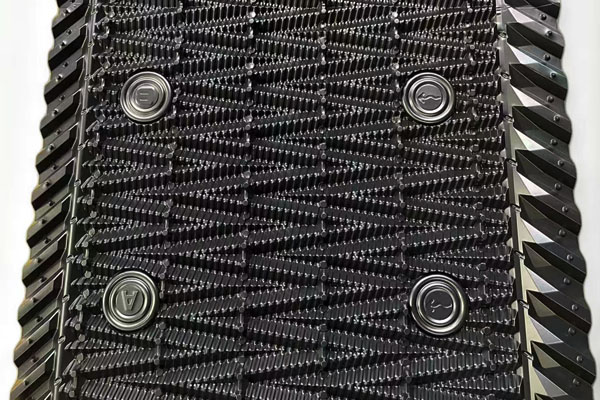
For counterflow applications, Film Fill Cooling Tower provides the large contact area used for air-water heat transfer. The selected fill height and structure should still match the tower's actual design conditions.
Water quality can affect the long-term condition of Cooling Tower Media. Scaling, suspended solids, and biological growth may restrict fill passages and reduce performance.
For this reason, the replacement decision should consider not only the tower dimensions but also the water treatment and maintenance conditions.
Older cooling towers often require more careful dimensional checking than new installations. Where several fill widths are possible, Multi-Specification Cross Flow Cooling Tower Fill can be useful for projects requiring different width specifications.
For replacement work involving existing crossflow sections, 1060mm & 1160mm Cross Flow Cooling Tower Fill for Replacement Projects is another example of why actual installation dimensions should be confirmed before production.
Before ordering Cooling Tower Fill, measure the actual installation space and review the tower's water distribution, airflow, water quality, and operating conditions.
A replacement fill should be selected according to the complete application rather than dimensions alone. Accurate information at the purchasing stage can make installation easier and reduce the risk of choosing an unsuitable Cooling Tower Media product.
Cooling Tower Fill Media industry updates and technical insights for global clients.
As industries continue to focus on energy efficiency and water conservation, cooling tower fill has

Why Fill Block Depth Matters More Than Its Width in Some Counterflow ApplicationsWhen purchasing rep
Get in touch with our team for cooling tower fill media details, quotations, and project technical support.
Chat on WhatsApp