
As industries continue to focus on energ
How to Choose Cooling Tower Fill When Re

The global cooling industry is experien
Cooling systems in chemical plants often operate under more demanding conditions than standard commercial applications. High temperatures, process contamination, chemical exposure, and complex water quality conditions can all affect cooling tower performance.
Inside the cooling tower, the Cooling Tower Fill plays an important role in heat transfer efficiency and long-term operating stability. Selecting the wrong fill material or structure may lead to faster degradation, reduced cooling capacity, and increased maintenance requirements.
For chemical plant operators, choosing the right Cooling Tower Media requires more than comparing cooling efficiency. Material compatibility, operating environment, and maintenance conditions must all be considered.
Chemical manufacturing facilities often rely on cooling systems to maintain stable process temperatures. Even small reductions in cooling performance can affect production efficiency and equipment reliability.
A suitable Cooling Fill solution helps improve:
Chemical plants may contain various substances that can affect plastic materials inside cooling towers.
The selected fill material should be evaluated based on actual chemical exposure conditions rather than general assumptions.
Some chemical processes operate with higher water temperatures compared with standard HVAC applications.
Under these conditions, material selection becomes especially important because temperature can influence the service life of Cooling Tower Fill.
Cooling tower water in chemical facilities may contain higher levels of dissolved minerals, suspended solids, or process-related contaminants.
These conditions can increase the risk of scaling, fouling, and reduced heat transfer performance.
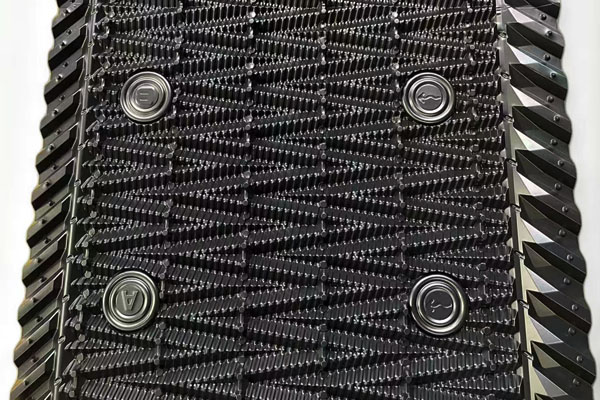
Film Fill is widely used in applications where high cooling efficiency is required.
Its design creates a large contact surface between water and air, helping improve heat exchange performance.
For applications requiring efficient film-type heat transfer, Film Fill Cooling Tower can be evaluated according to the tower design and operating conditions.
For crossflow cooling tower replacement projects, Multi-Specification Cross Flow Cooling Tower Fill provides a multi-width option for projects where existing tower dimensions need to be matched.
Some chemical plant cooling systems may require stronger resistance against fouling or suspended solids.
Splash Grid Fill can be considered for applications where durability and easier cleaning are important factors.
Compared with fine-structured film fill, splash-type solutions may offer advantages in certain difficult water environments.
PVC Cooling Tower Fill is widely used in many industrial cooling applications because of its reliable performance and economical cost.
For chemical applications with suitable operating conditions and controlled water quality, PVC can provide excellent value.
PP Cooling Tower Fill is often selected for more demanding environments where higher temperature resistance or improved chemical stability is required.
However, choosing PP does not automatically solve every chemical compatibility issue. The actual operating environment should always be reviewed before selection.
Before selecting Cooling Tower Media, operators should consider:
Fouling can reduce the effective surface area of Cooling Tower Fill and decrease heat transfer efficiency.
A suitable fill design should balance cooling performance with maintenance requirements.
Chemical plant cooling towers often require planned maintenance.
The selected Cooling Fill should allow practical inspection and cleaning procedures.
Long-term exposure to unsuitable chemical conditions may cause plastic materials to weaken or deform.
Scale, deposits, and biological growth can reduce the effective heat transfer area of the fill.
Choosing a fill only based on initial cost may result in more frequent replacement and higher long-term expenses.
During cooling tower maintenance projects, chemical plants should also review related components.
Chemical plant cooling towers require a balanced approach. The highest cooling efficiency is not always the best choice if the material cannot withstand the actual operating environment.
A successful Cooling Tower Fill selection should consider cooling performance, material compatibility, maintenance requirements, and expected service life together.
PP can be a better choice for some demanding applications, but the correct material depends on actual temperature, chemical exposure, and operating conditions.
Yes. Film Fill is widely used in many industrial cooling towers when water quality and operating conditions are suitable.
Proper material selection, water treatment, regular inspection, and correct maintenance practices can help extend service life.
Selecting Cooling Tower Fill for chemical plants requires understanding the complete operating environment. Material choice, cooling tower design, water quality, and maintenance planning all influence long-term performance.
By selecting the right Cooling Tower Media solution, chemical facilities can improve cooling reliability, reduce maintenance risks, and achieve more stable operation.
Cooling Tower Fill Media industry updates and technical insights for global clients.
As industries continue to focus on energy efficiency and water conservation, cooling tower fill has
Cooling Tower Maintenance in Food and Beverage Plants: When Fill Fouling Becomes a Production Proble
Get in touch with our team for cooling tower fill media details, quotations, and project technical support.
Chat on WhatsApp